2.3 The pinna — vertical localization
The outer ear flap (the pinna) is not just decoration. It is the part of the body that performs vertical and front-back sound localization, encoding angle information into the spectrum of the signal that reaches the eardrum.
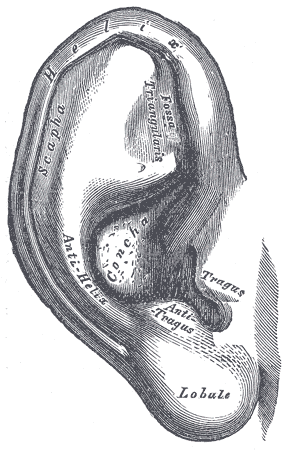
The pinna is geometrically complex — folds, ridges, the concha, a curved entry to the ear canal — at scales comparable to the wavelengths of high audible frequencies (roughly 1 to 4 cm, corresponding to 8.5 to 34 kHz). Sound arriving from different elevations is reflected, diffracted, and attenuated differently by the pinna, producing characteristic spectral notches and peaks that depend on elevation. The auditory system learns to read these spectral fingerprints as elevation cues.
The clearest single feature is the pinna notch — a narrow drop in the spectrum at a frequency that depends on elevation. For sounds from directly ahead, the notch is around 8 kHz; for sounds from above, it shifts to higher frequencies; for sounds from below, it shifts lower. People with their pinnae temporarily filled with putty perform dramatically worse on vertical-localization tasks; the spectral cues are gone.
The pinna’s importance for vertical localization is one reason why broadband sounds (with energy across the high frequencies) are easier to localize vertically than narrowband ones. A pure 1 kHz tone has no pinna-cue information, because all the encoding happens at frequencies above ~3 kHz where the pinna’s geometry interacts with the wavelength.